

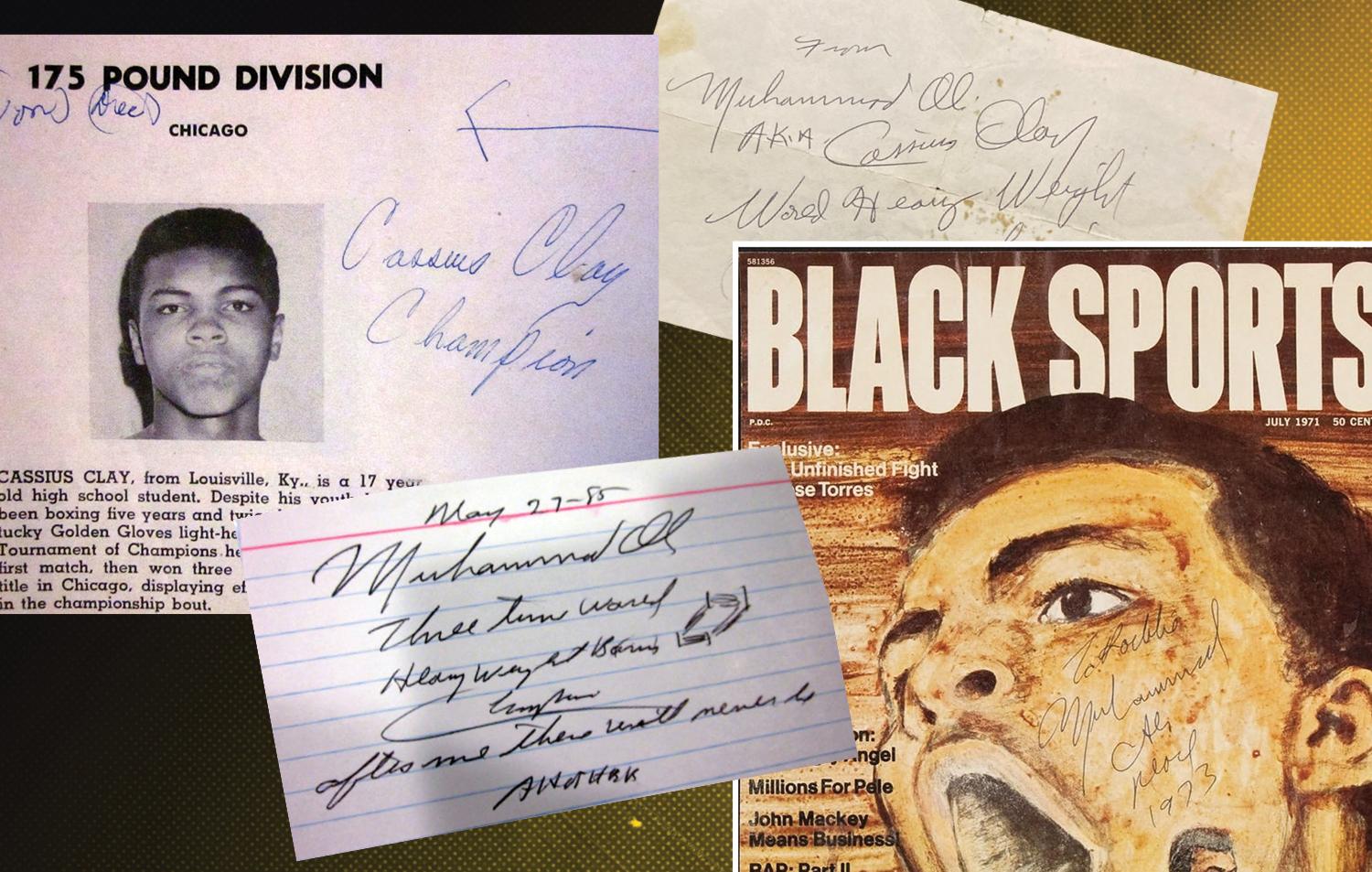
Written by James J. Spence III

"I don't have to be what you want me to be. I'm free to be what I want."
Muhammad Ali lived his life with complete authenticity, never pretending to be anyone other than himself. In the sports memorabilia hobby, where a flood of counterfeit Ali items continually hits the secondary market, keeping the real stuff separated from the phonies is our daily mission. Protecting the genuine article is the exact reason his authentic signature continues to command blue-chip value.
Ali is easily one of the top 10 most submitted signatures we examine at JSA worldwide. Working directly with major auction houses, collectors, investors, and dealers gives us access to rare, fresh material. When pieces are dated, we file them chronologically because everyone's handwriting transforms over time. To authenticate accurately, you must compare a piece to like-period examples rather than relying on one static image.
In-Person Encounters: Meeting "The Greatest"
Growing up in Orwigsburg, Pennsylvania, I lived minutes from Deer Lake. Boxing fans remember Deer Lake as "Fighter's Haven," Ali's training camp in the woods where he endured freezing winter conditions to prepare for Joe Frazier.
Ali's generosity with his pen came from personal experience. As a young boy, his idol Sugar Ray Robinson brushed him off with a harsh "Not now, kid." That heartbreak led Ali to promise he would never turn down a child's autograph request. He loved kids, often saying, "I love children, they never lie to you. If they don't like you, they tell you. If they like you, they tell you."
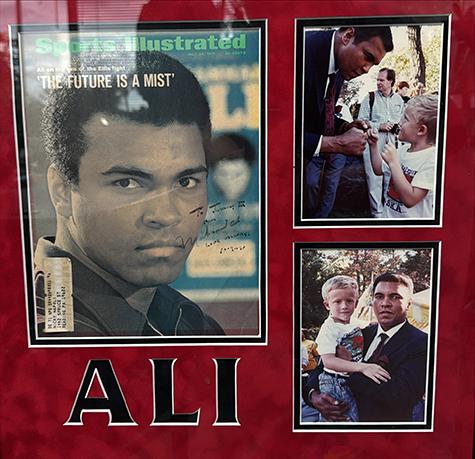
In the early 1990s, our local paper ran a tiny notice about Ali visiting the area. When I went to see him, Ali saw that I was one of the youngest kids there. He walked right over, performed a few magic tricks, and picked me up for a photo when he saw my dad's camera (pictured below). He even threw up a boxing pose with me and signed my Sports Illustrated: "To Jimmy III from Muhammad Ali Love Always." Seeing his kindness up close gave me a lifelong appreciation for his autograph.
Signature Evolution: Decade by Decade
Here is how Ali's signature evolved over time and key traits to look for:
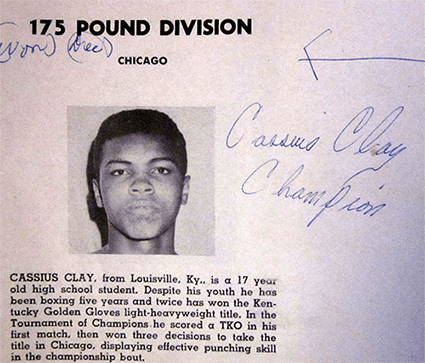
Early "Cassius Clay" (1959 to 1964): One of our earliest JSA exemplars dates to 1959, signed "Cassius Clay" with the bold inscription "Champion." These early signatures show smooth, open cursive loops.
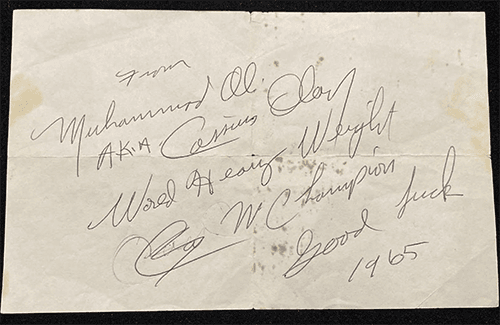
The Transition (1965 to 1966): After his name change, items signed across 1965 and 1966 often feature both "Cassius Clay" and "Muhammad Ali" together.
The Flamboyant 1970s: During his championship prime, his signature became much larger and flamboyant. By 1967, he signed "Muhammad Ali" regularly and stopped penning his birth name on public mail.
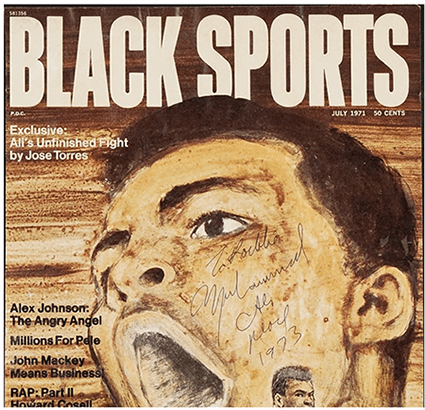
The 1980s (Shrinking Size and Scripture): In the 1980s, the signature stayed complete but shrunk in size. Ali wrote frequently during this era, often penning Quranic scripture on Islamic pamphlets for mail requests. You could still read every letter with good pen speed.
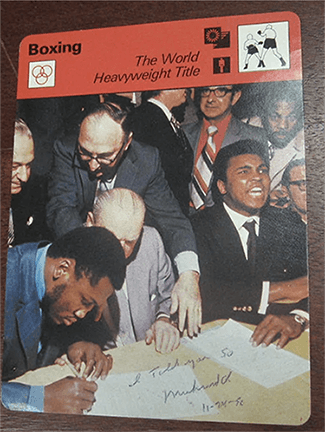
The 1988 Signing Boom: Around 1988, promoters realized the rarity of his birth name and began paying him extra money to sign "Cassius Clay." Ali still signed "Muhammad Ali" by default unless specifically paid that premium. Genuine Clay pieces continue to sell at much higher prices.
The Early 1990s (Promoters and Health Decline): Parkinson's began to deteriorate his handwriting, making it noticeably smaller. Card show promoters booked him for massive signings, like the famous sessions captured by dealer Lou Scalia of Stacks of Plaques. Supply grew, but demand remains just as massive.
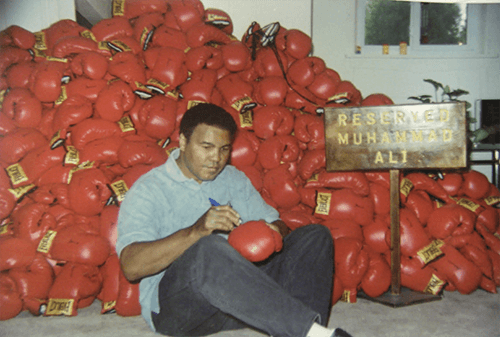
The 2000s (Heavy Variation): Late in life, his handwriting suffered drastic declines. At times, we cannot comfortably authenticate items from this era because stroke directions and flow conflict with our established baseline files.
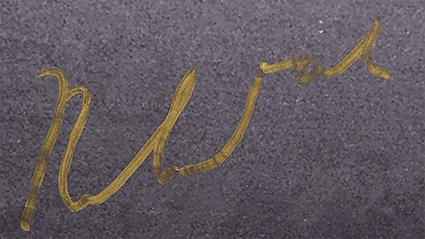
Secretarials and Belinda Ali: Non-authentic secretarial signatures exist across his entire career. Starting in the early 1970s, his wife Belinda Ali regularly signed fan mail and personal checks. While the ink is period-correct, her versions have obvious sizing and letter formation flaws that make her hand easy to identify.
Inscriptions, Fakes, and Values
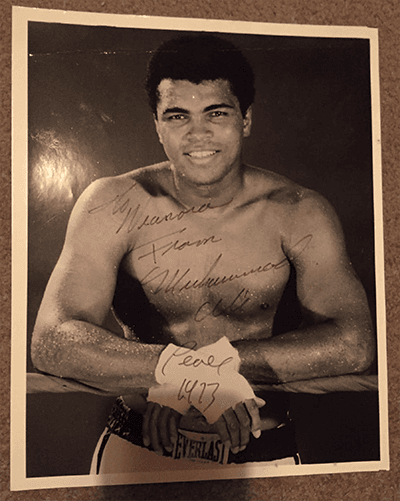
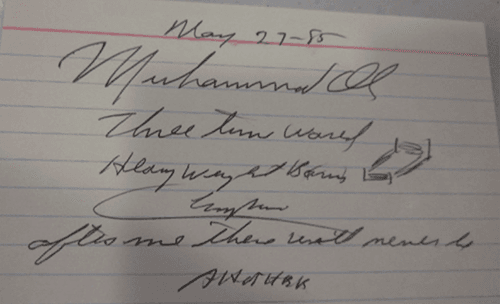
Inscriptions and Value Tampering: Authentic inscriptions (like the one pictured below) include "Peace," "Love," "Champion," Quranic verses, and "The Greatest." Be extremely careful when buying inscribed pieces: At times, forgers will take a genuine, uninscribed signature of Ali and add a forged inscription in an attempt to drastically enhance the perceived value, sometimes doubling it. Always look closely at the pen work. If you notice two different shades of ink or differing pen pressure between the signature and the added text, treat that as an immediate warning sign, especially on rare, unique, or uncommon inscriptions.
Forgery Risk: Extremely High. Market saturation of fake gloves and traced prints makes professional verification critical.
Auction Results: Truly historic, hand-signed Ali pieces can bring major auction results. One prime example is Muhammad Ali's original signed contract for the "Fight of the Century" against Joe Frazier, which realized $24,000 through a Goldin auction with JSA authentication.
Value Breakdown (JSA Authenticated)
Signed Cuts / Index Cards ("Muhammad Ali"): $250 to $500
Autographed 8x10 Photos ("Muhammad Ali"): $450 to $850+
Signed Boxing Gloves ("Muhammad Ali"): $1,000 to $2,500+
"Cassius Clay" Signed Gloves / Photos (Post-1988 Signings): $2,500 to $5,500+
Vintage Early "Cassius Clay" Items (Pre-1967): $6,000 to $15,000+
Related Links: