

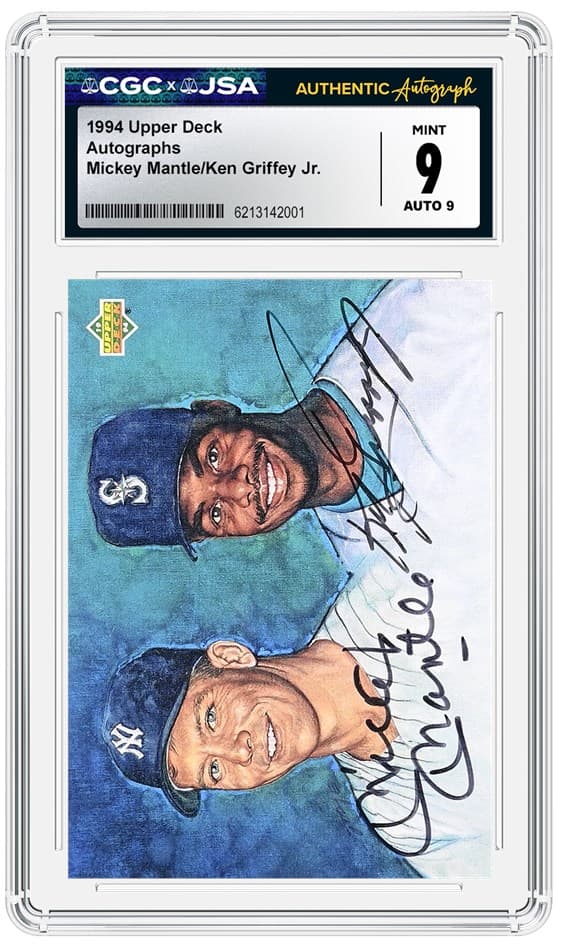
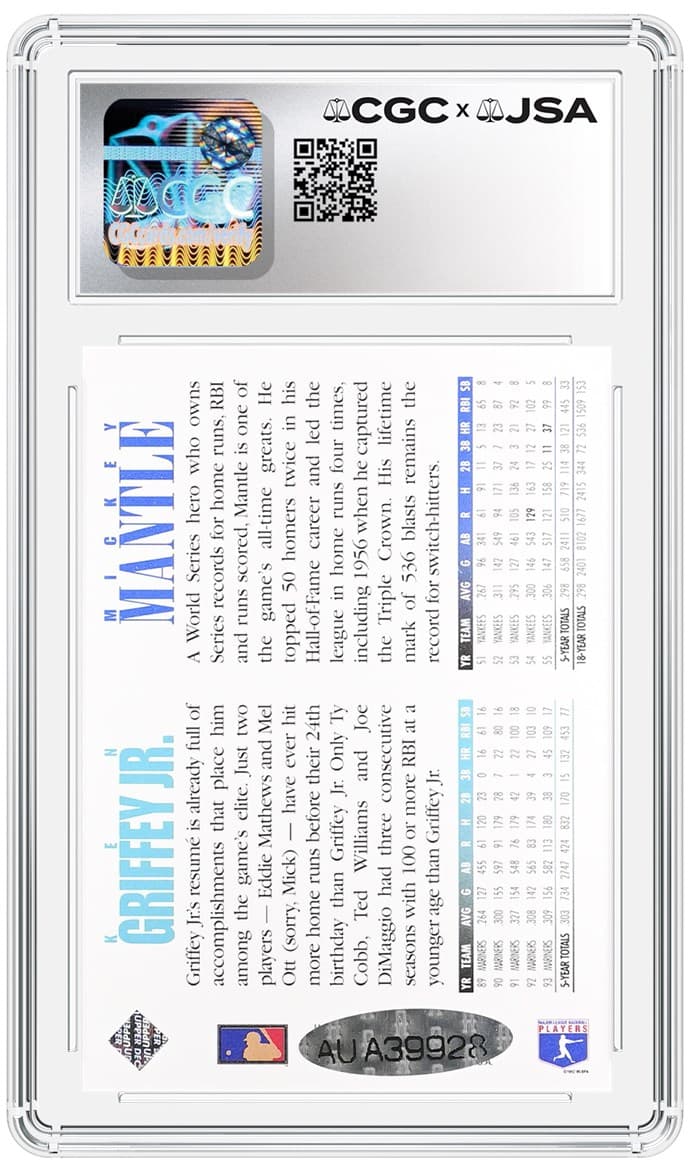
A modern grail of 1990s sports cards was recently submitted for dual CGC and JSA services. The 1994 Upper Deck Autographs Mickey Mantle / Ken Griffey Jr. earned a grade of CGC 9, with an autograph grade of JSA 9, tying it with one other example for the Top Pop in the CGC Cards Population Report.
While there are three different versions of the card (signed by Mantle and Griffey Jr., signed by Mantle only, and signed by Griffey Jr. only), this particular card is an original copy signed by both of the legendary center fielders before the card was released. As the most desirable of the bunch, this is arguably the most coveted single baseball card of the entire decade.
The 1990s were an interesting time for sports card makers and collectors alike. Although collector interest was at an all-time high, as the '80s gave way to the '90s, card makers printed far too many sports cards. From roughly 1986 to 1993, companies like Topps, Donruss, Fleer, Score, and Upper Deck flooded the market with mass-produced sets, quickly outpacing demand. The overproduction led to a sharp decline in card values, with even the most sought-after cards being common and nearly worthless at the time.
Due to a lack of rarity and value, collectors began to lose trust in card makers and the hobby. Something had to change, and Upper Deck realized it, transitioning away from the mass-produced base card format. Instead, Upper Deck shifted its focus, putting an emphasis on inserts and rarer cards with a much lower production count in hopes of renewing collectors' interest.
This shift brought about a groundbreaking collaboration by Upper Deck when the company combined MLB history with present day greatness, pairing two of the best center fielders to ever play the game on one limited insert. The 1994 Upper Deck Mantle-Griffey dual auto card quickly became the most talked about card on the market and its importance for the future of the hobby still reverberates to this day.
Signature Analysis by James Spence III, JSA Senior Vice President
The 1994 Upper Deck Autographs Mickey Mantle and Ken Griffey Jr. insert remains a crown jewel of modern collecting. The rarity is well known for featuring iconic portrait artwork of each of the two generational legends on one card, with copies signed by both superstars, only Griffey, or only Mantle. Making the card that much more special, Mantle signed the cards just a year prior to his passing in 1995.
Upper Deck issued only 1,000 pack-pulled cards with the dual autos, alongside 1,000 single-signed cards for each player. However, the high demand and high cost of Mantle’s signature in 1994 made aftermarket Mantle additions onto Griffey-only cards virtually non-existent, whereas many collectors wisely paid to have the accessible, living Griffey sign their Mantle-only cards years later.
Mantle himself always maintained a sharp wit regarding his immense autograph demand late in life, once joking during a speech: "I dreamed I died and went to the Pearly Gates, and St. Peter said, 'Sorry Mickey, because of how you lived, you can't come in... but before you leave, would you mind autographing these baseballs for Him?'"
Original 1994 pack-pulled dual autos can be identified by a finer pen tip used for Griffey's signature, with the Mariners star signing neatly side-by-side with Mantle along the bottom. Later additions usually stand out because Griffey often used a thicker Sharpie, signed higher up on the card, or used his slightly evolved, modern signature style.
Remarkably, across all submissions evaluated to date, JSA authenticators have yet to encounter a single forged hand signature on either player for this specific card stock. However, collectors must beware of high-resolution photocopies sold as genuine hand-signed originals, making an illuminated, high-magnification loupe essential for spotting telltale printed halftone dot patterns versus authentic liquid ink layered above the surface.
Reflecting its status as the ultimate modern "grail," the card's market value has steadily escalated from around $1,000 at its 1994 release to $3,500 in 2004, $8,000 in 2014, and exploding up to $15,000 to $25,000 raw today with high-grade copies commanding a record $90,000 or more.
Related Links: